
- The Environmental Education programme helps to raise environmental awareness among citizens, which leads to a better understanding of water resources and more sustainable behaviour.
- The actions are part of the ambitious ‘Canya a la Canya’ plan, developed together with the Limne Foundation in 13 municipalities.
- The actions are supported by the Biodiversity Foundation of the Ministry for Ecological Transition and Demographic Challenge (MITECO) within the framework of the Recovery, Transformation and Resilience Plan (PRTR), financed by the European Union – NextGenerationEU.
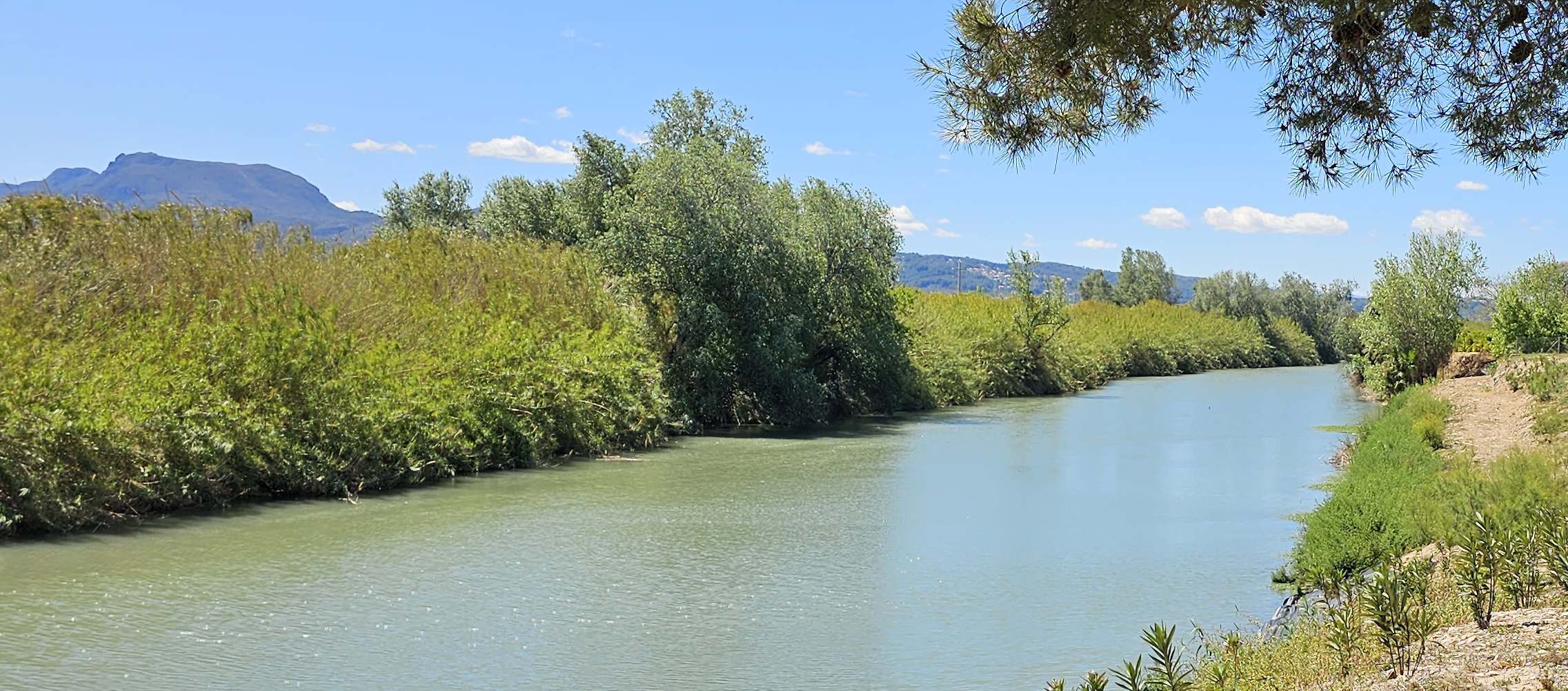
14 March 2024. The ‘Canya a la Canya’ project, coordinated by the Consorci de la Ribera and the Fundació Limne, reiterates its commitment to environmental education as one of the pillars for raising awareness of the aquatic environment and its ecosystem, making society aware of the problems threatening the Xúquer, such as the presence of invasive species or climate change, and providing keys and mechanisms for its conservation and improvement.
With the aim of strengthening training in environmental issues, the ‘Canya a la Canya’ team presented an Environmental Education Toolkit at the beginning of the school year, whose lines of action will be rolled out during this semester.
The aim of the guide is to provide teachers with reference materials on how to integrate river-related topics and concepts into formal and informal education systems. The guide contains various proposals dealing with topics such as climate change, drought, flood risks, biodiversity, solid waste and ecosystem restoration, among others.
In addition, the workshop proposals encourage students to leave the classroom and visit the natural environments of the municipalities where the campaign is being implemented, so that they can acquire practical knowledge and environmental awareness about protecting our environment, both water resources and the environment, through different activities adapted to each school level, which also explain concepts related to the water cycle, the concept of water footprint, and what public water resources are.
Links to the students’ everyday reality
The programme has been adapted to establish links between the students’ everyday lives and the ‘Canya a la Canya’ project, making it easier for them to understand. The close relationship between the students and the project area has proven the effectiveness of this approach.
‘It is our responsibility to take the first step in strengthening and adapting environmental education processes to our local reality. This will undoubtedly contribute to the active participation of present and future generations in the protection and conservation of the environment,’ says Óscar Navarro, president of the Consorci de la Ribera. In this regard, he adds, ‘it is essential to invest in environmental education programmes, training and flexible resources for teachers and trainers, as they are the ones on the front line of change in schools and communities.’
According to sources at the Limne Foundation, this practical guide ‘will help improve training and skills in nature conservation and its links to the Sustainable Development Goals.’
During this school year, more than 7,500 students are expected to participate in the nearly 400 workshops planned for the 29 schools that have joined the campaign.
This proposal benefits from a call for grants, promoted by the Fundación Biodiversidad of the Ministerio para la Transición Ecológica y el Reto Demográfico (MITECO), for the restoration of river ecosystems and the reduction of flood risk in urban environments, within the framework of the Recovery, Transformation and Resilience Plan (PRTR) financed by the European Union – NextGenerationEU.