
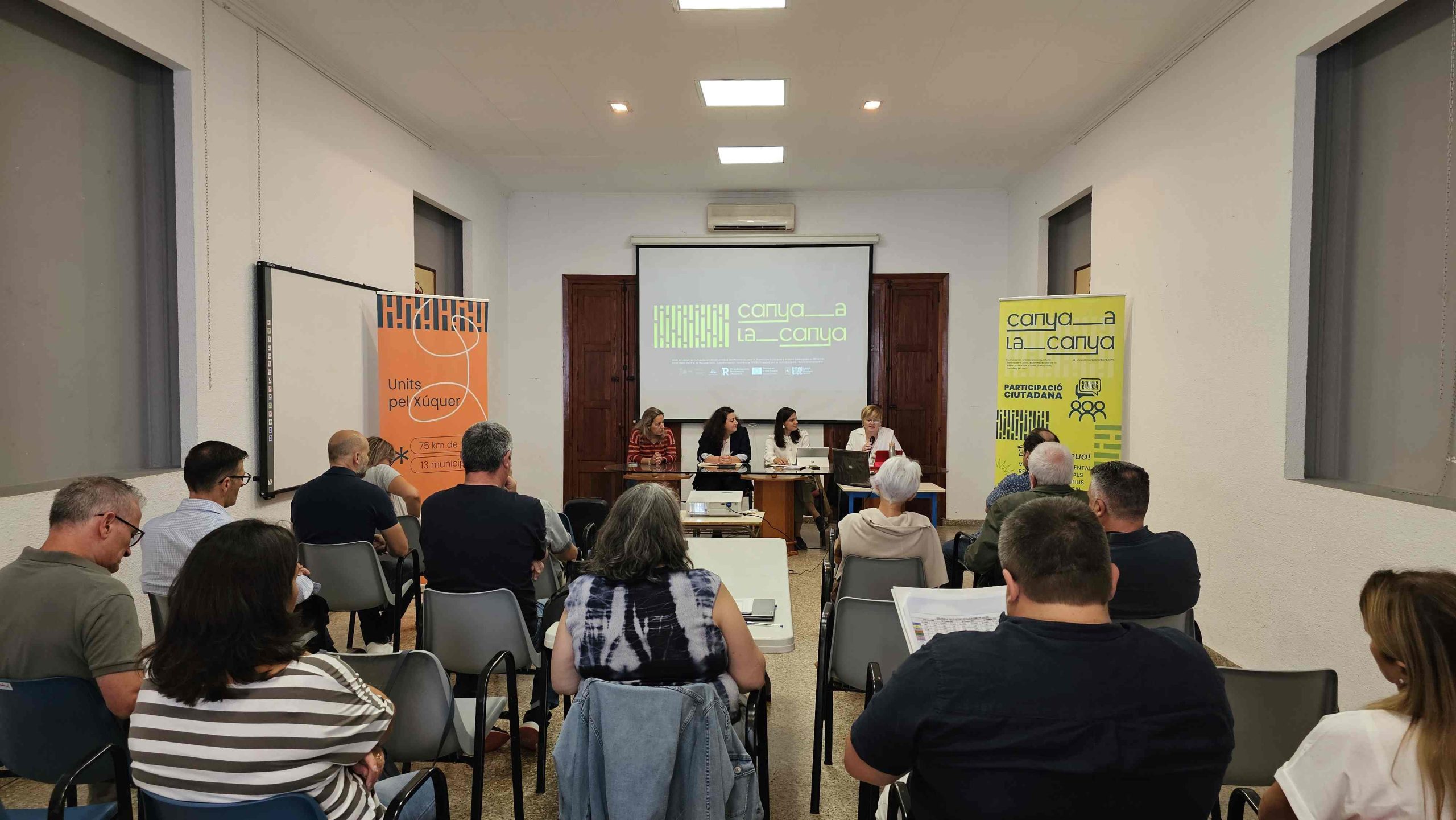
- The programme, which is now halfway through with most of the actions completed, has organised a conference to explain its results and work on the continuity of the initiative.
- ‘Canya a la canya’ is a project developed by the Consorci de la Ribera and the Limne Foundation in 13 municipalities in the lower Xúquer basin.
- The project is supported by the Fundación Biodiversidad oh the Ministerio para la Transición Ecológica y el Reto Demográfico (MITECO) within the framework of the Recovery, Transformation and Resilience Plan (PRTR), financed by the European Union – NextGenerationEU.
19 September 2024.- The ‘Canya a la Canya’ project, coordinated by the Consorci de la Ribera and the Limne Foundation, held a conference today to highlight the success of the programme, an ambitious project that is part of the National River Restoration Strategy and aims to conserve and improve nearly 75 km of the Xúquer River between the towns of Sumacàrcer and Cullera.
During the conference, the importance of working together was emphasised to the mayors of the consortium’s municipalities. This was explained this morning by the president of the Mancomunitat de la Ribera Alta, Paqui Momparler Orta, representing the Consorci de la Ribera, during the opening of the conference, who stated that “through the application of Nature-based Solutions such as the control and management of Invasive Alien Species, restoration of riverbanks, transformation of abandoned farmland into river areas, stabilisation of riverbanks and bioengineering, we are managing to improve the resilience of this stretch of the Xúquer river against episodes of flooding, actions that are now reaching their halfway point and have been accompanied by a series of measures and interventions aimed at strengthening citizen participation”.
Representing the Biodiversity Foundation were Victoria Pérez García, coordinator of the Foundation’s Cities Area, and Adrián Brox, tutor of the Canya a la Canya project. Cristina Sola García, Water Commissioner of the Júcar Hydrographic Confederation, was also present.
In this context, Canya a la Canya, as a collaborative initiative, has demonstrated that a paradigm shift in the governance model is possible, energising citizens through various initiatives that promote deliberative processes that can have a significant impact on municipal policies.
During her presentation, the Water Commissioner of the Júcar Hydrographic Confederation also highlighted the need for this type of programme, based on strategic policies, to be ongoing, recalling that responsibility for actions on public roads located in urban areas lies with local authorities, in accordance with the provisions of the National Hydrological Plan. To this end, the Agency has set up a new procedure, aimed specifically at local councils, which simplifies the preliminary procedures required to carry out conservation and maintenance work on river sections. The Hydrographic Confederation also sees river stewardship as a complement to these conservation tasks, as well as a useful tool for ensuring the progressive involvement of civil society in the protection and defence of natural resources, thereby contributing to the achievement of two of the objectives of the Water Framework Directive: public participation and the achievement of good ecological status of water bodies.
Finally, the event featured a presentation of ways to continue the ‘Canya a la Canya’ project over time and a debate in which various municipal representatives explained first-hand the impact of this initiative in their localities and the importance of making the Xúquer a cross-cutting axis of the environmental policies of the municipalities it crosses.
This proposal benefits from a call for grants, promoted by the Fundación Biodiversidad of the Ministerio para la Transición Ecológica y el Reto Demográfico (MITECO), for the restoration of river ecosystems and the reduction of flood risk in urban environments, within the framework of the Recovery, Transformation and Resilience Plan (PRTR) financed by the European Union – NextGenerationEU.