
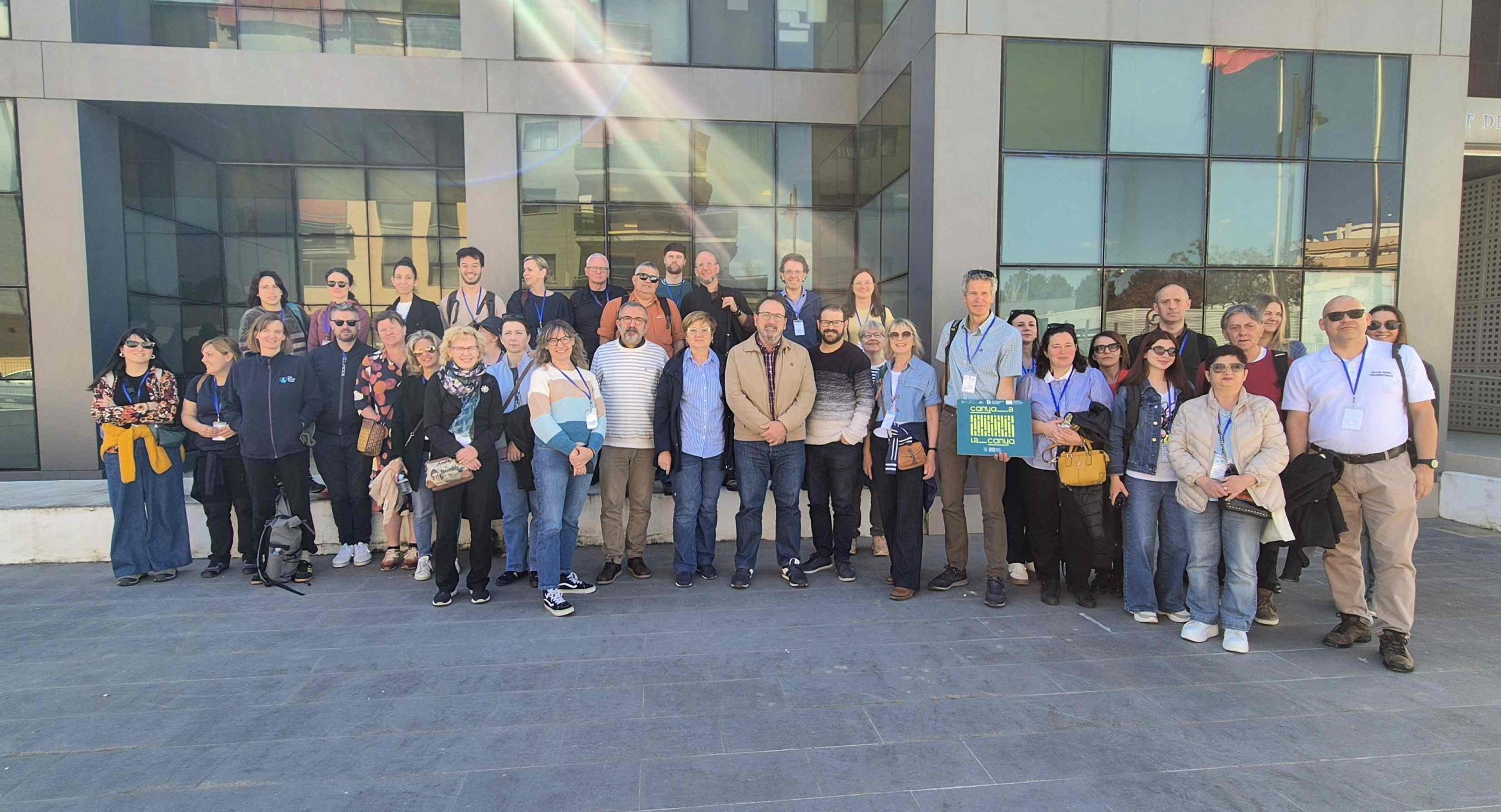
- The European partners of the Interreg RIWET project see the damage caused by the DANA first-hand.
- The “Canya a la canya” project has been selected as a best practice in flood management.
- “Canya a la canya” is supported by the Fundación Biodiversidad of the Ministerio para la Transición Ecológica y el Reto Demográfico (MITECO) as part of the Recovery, Transformation and Resilience Plan (PRTR), funded by the European Union – NextGenerationEU.
26 March 2025. European partners in the Interreg RIWET initiative, from Albania, Slovenia, Finland, Greece, Ireland, Latvia, the Netherlands, Poland and Ukraine, visited our region this week to study the effects of last October’s DANA.
The ‘Canya a la Canya’ project, coordinated by the Consorci de La Ribera and the Limne Foundation, has been chosen as a good practice in water governance by the RIWET group, which visited the headquarters of the Consorci de la Ribera to learn more about the design and results of the project, with the aim of gaining in-depth knowledge and replicating it in their territories. The European delegates have shown great interest in including the governance mechanisms of ‘Canya a la Canya’ in a forum of innovative management experiences that seeks to promote better restoration of the continent’s rivers through the creation of a model of negotiation and exchange networks involving all the agents and stakeholders involved in the different areas of water management.
The successful experiences of ‘Canya a la Canya’ are part of a commitment to placing social dialogue at the heart of restoration policies, as well as the joint coordination of restoration work from a municipal perspective.
Since 2022, ‘Canya a la Canya’ has been carrying out numerous actions to remove invasive reeds from the banks of 13 municipalities in the lower Júcar basin, using joint river restoration strategies that strike a balance between restoration and flood risk management. In addition to removing reeds, numerous actions have been carried out to stabilise riverbanks and expand the floodplain so that the river can spread out in the event of extraordinary floods.
This is an ambitious project within the framework of the National River Restoration Strategy, which aims to conserve and improve nearly 75 km of urban stretches of the Xúquer River between the towns of Sumacàrcer and Cullera.
The effects of the DANA on the activities that have not yet been completed have aroused great interest among the members of ‘Interreg RIWET’, who have taken note of which actions best withstood the onslaught of water, aimed at the recovery of river spaces or the elimination of longitudinal and transverse barriers and obstacles within the Public Water Domain.
After assessing the damage to the areas of action, the coordinators of ‘Canya a la canya’ explained the project’s planned actions, such as transforming abandoned farmland into river drainage areas, stabilising riverbanks and combating the presence of reeds. However, they added that they will be implementing a series of actions and interventions aimed at strengthening citizen participation, i.e. involving local residents in decision-making processes regarding the actions to be carried out or generating debate on current land use planning.
The ‘Canya a la canya’ project benefits from a call for grants, promoted by the Fundación Biodiversidad of the Ministerio para la Transición Ecológica y el Reto Demográfico (MITECO), for the restoration of river ecosystems and the reduction of flood risk in urban environments, within the framework of the Recovery, Transformation and Resilience Plan (PRTR) financed by the European Union – NextGenerationEU.